Industry Trends • Dec 5, 2025 2:56:25 PM • Written by: Rashed Chowdhury

The Gartner Hype Cycle was developed as a model for how attitudes change over time around emerging innovations and technologies. It exists on a 5-point scale, starting from the moment an innovation is released (the Innovation Trigger stage) and ending being actually productive (the Plateau of Productivity). What happens in the middle in terms of timing is up to the innovators, marketing, funding, and other upper-funnel factors.
Enter pretotyping. It’s just what it sounds like – testing the prototype pre-investment – and the ultimate hack for shortening the period of growing pains. It’s a particularly helpful market research technique for technologies that either aren’t fully developed yet or that are too expensive to risk developing without a precise knowledge around consumer demand. Pretotyping validates the actual demand for a product before actually going to market or investing resources into development.
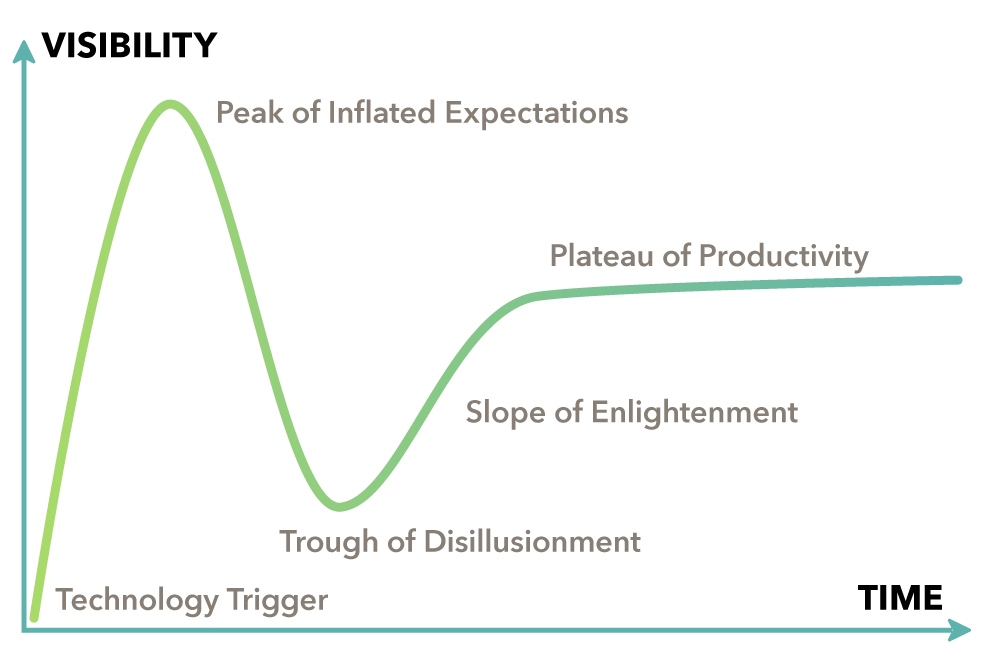
It’s easy to get caught in the Hype Cycle. Innovative ideas get abandoned, launched too soon, or without the right messaging. That means more overhead to get it right, and a longer time before your product starts to do well and the dust settles into a predictable and steady upswing.
Pretotyping with strategies like testing in the wild mitigates time spent figuring out how to spend more time in the profit-generating zones and less in the valleys of uncertainty.
Take a smoother ride through the Hype Cycle with behavioral metrics
The data you get from real-world research helps everyone from marketers to stakeholders to lessen or even circumvent dips in the hype cycle altogether.
Testing is more effective, more accurate, and overall less risky than starting out on assumptions and unsteady ground or scrambling around a failure to launch. Pretotyping with in-feed assets that reach a target consumer audience, for example, is most effective as a market research tool after you complete your qualitative research, before you put any assets into development.
For example, imagine you’re testing a new AI speech-to-text software and are looking for key differentiators to stay disruptive in a noisy AI-dominated landscape. By creating “fake door” tests and prompting scrollers with digitally native assets, there's an added filter that collects real qualitative data. It’s less expensive than prototyping, which requires actual development costs. Users volunteer wish-list features or major pain points of pre-existing AI speech-to-text software that help you to develop into the actual needs of the market rather than the perceived ones.
Real-world testing...
- Weeds out ideas that’ll slow you down. Less speed bumps means you’ll get to your destination faster, with fewer potential flops due to under-researching your market, so you get an idea of in-market performance and reception of the final product before it’s even in the hands of consumers.
- Focuses on what’s real, not just hype. By breaking down real consumer demand and pain points rather than relying on “vibes”, you’re able to fine-tune everything around the service or solution your innovation is providing, from messaging to actual use cases.
- Hones in on the right version of your idea to keep targets focused. Brands often get caught in the Hype Cycle when overdeveloping, dropping them in the Through of Disillusionment until they get laser-focused, because the first iteration of an innovation is mismatched with what consumers actually asked for.
- Creates insights that will help you survive the hype cycle. So when adoption dips, you’ll have actual data to help renew value propositions without resorting to flawed survey data or vague intuition.
Is it possible to skip the disillusionment stage entirely?
With precision testing, a dedication to not letting hype outpace reality, and validating demand early enough, it is possible.
1. Staying grounded
Most technologies fall into the Trough of Disillusionment because early expectations go too far beyond what the realistic product can deliver.
If you keep claims grounded in reality, launch with intention, and let real user behavior be your guide, you can avoid the plummet.
Examples:
- Slack grew steadily inside teams before going public; no excessive hype → no Trough.
- Figma focused on optimizing real workflows and building community before making big promises.
Their success is thanks to the building of momentum, not mania.
2. Validate, validate, validate.
This is where pretotyping and MVP-style testing work together for your best chances at skipping the Trough of Disillusionment altogether.
By confirming behavior early, you’re less likely to get blindsided later by the “nobody asked for this” moment.
Examples:
- Zappos validated behavior before launching the real service.
- Dropbox validated demand with a video, so they launched into actual adoption.
These companies didn’t frontload, so they never had to overcorrect in ways that tend to land you in the disillusionment phase for longer than necessary.
The Gartner Hype Cycle was ideated as a visual representation of what can be expected when engineering and releasing new technology
It’s not one-size-fits-all – not only because every innovation is different, but because the way you do your market research has as much to do with the success of your idea as the idea itself.
Real-world testing isn’t the pretotyping of the past. It’s the sieve that catches vital behavioral information that you won’t get from survey data that’s inherently flawed because participants are aware of their observable position, which welcomes biases, preferential answers, and other factors which skew your findings into the aspirational rather than the realistic.