Say-do Gap Experiments • Aug 28, 2026, 10:00:00 AM • Written by: Gracey Mussina

Each month, we choose a potential say-do gap to put to the test. Consumers may think they know themselves and their habits, but how well do they, really? We know survey data is flawed, and in previous experiments, we've seen where consumers' best intentions break down in the real world. This month, our in the wild experiment is tackling whether Gen X's stated balance between health and indulgence actually holds up when a candy craving hits. Do you think it holds true? Let's find out.
Gen X: Under-targeted, under-tested
Gen X will lead global consumer spending through 2033, according to Nielsen, with spending from this generation reaching $23 trillion in 2035.
Most brands still act like they didn't hear that.
Sandwiched between Baby Boomers and Millennials, Gen X gets called the forgotten generation so often it's practically their punchline, and some of them will even tell you they're fine with it. But forgotten doesn't mean unmotivated. It means under-tested.
The say
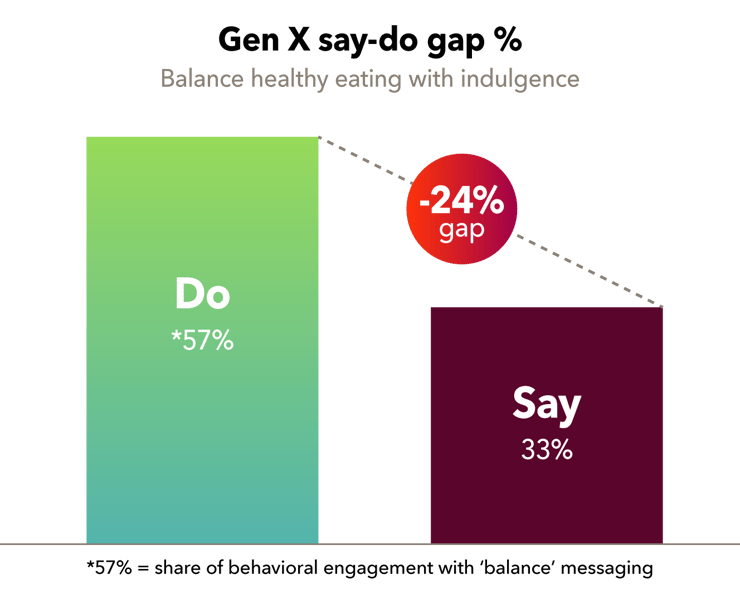
33% of Gen X says they balance healthy eating with indulgence. It's a modest number, and one that fits the stereotype: a generation that keeps things practical and doesn't overclaim.
But Gen X is also managing a level of everyday load that doesn't show up in a single survey question. They’re caring for aging parents, kids, managing careers, and trying to figure out their retirement situation with hardly any time left for themselves. Our hypothesis going in was that the weight of everyday demands might make an easy, permitted indulgence land harder than any message about balance ever could.
So we asked: does that 33% actually hold up when we test it in the wild?
The do
We built two unbranded ads using a retro visual template of a phone ringing, and dropped them into consumers' feeds. Both led with the same line: "Your sweet tooth called."
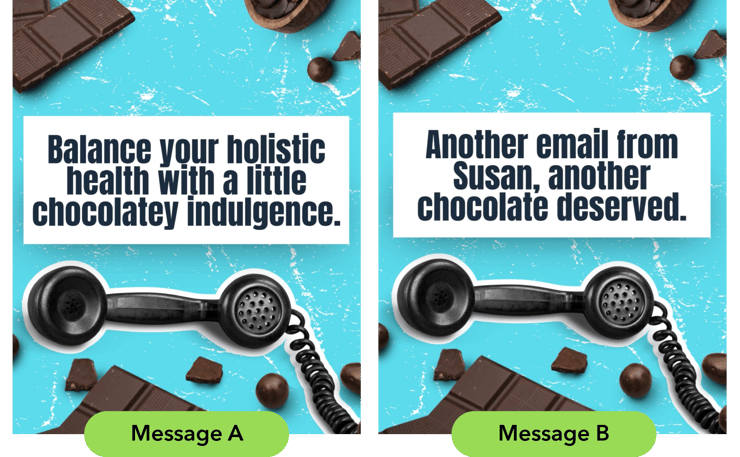
Message A tested balance: "Balance your holistic health with a little chocolatey indulgence."
Message B tested indulgence: "Another email from Susan, another chocolate."
The nostalgia was intentional. A ringing phone and a straightforward, unbranded template gave the message room to land without feeling like an ad trying too hard to identify Gen X as Gen X. We measured click-through behavior to see which message they actually engaged with.
Here’s what we found
Gen X undersold themselves. The balance message outperformed what the survey predicted, landing a -24% say-do gap.
Why the gap exists and what this tells us
Ask someone if they eat well, exercise, or manage stress responsibly, and the aspirational self tends to answer, inflating the survey numbers beyond what people actually do. That’s social desirability bias, and it’s the pattern we see most.
Gen X gave us a different signal. They didn’t inflate their healthy habits — they undersold them. Here's the more interesting part: the winning message wasn't really about chocolate.
"Balance your holistic health with a little chocolatey indulgence" worked because it didn't ask Gen X to choose between who they're trying to be and what they want right now. "You can have this and still be the person you're trying to be" beats "you've had a hard day, you deserve this," because it offers control alongside the reward instead of in place of it.
That distinction matters. Our fast food test found reward and permission driving Gen Pop as a hidden purchase motivator. Gen X still responds to reward, but the driver here looks different. Gen X isn‘t chasing "you earned this." They’re responding to "this fits into the life you’re trying to maintain." For a generation juggling responsibility on every front, control may be the more persuasive offer.
What this means for brands
Health and indulgence, responsibility and reward, family and self-care already coexist in Gen X's life. The balance message worked because it treated indulgence as something that fits inside a day stretched thin by aging parents, kids, careers, and retirement planning. That's the opportunity: meet Gen X where their life already is.
Gen X doesn't need brands to make a big deal about being Gen X. They need brands to understand the reality of their lives. Health and indulgence are both just part of getting through a Tuesday. A brand that resolves that tension for them is showing it actually understands what goes into their days. That's what earns trust with a generation that's gotten good at spotting performance.
For food and beverage brands positioning around health and nutrition, that means understanding where the product fits into their lives. Other categories have their own version of this gap. Financial services brands talking to Gen X about retirement are selling to people already deep in the math. Wellness brands pitching self-care are talking to people who've been managing everyone else's needs for a decade. Brands can recognize the effort consumers are already making and show how their products fit alongside it, rather than adding one more thing to manage.
Format matters too. For a generation that's tuned out traditional advertising, testing in socially native formats, like a consumer POV, a meme, or a lifestyle post through Orchard Seed testing surfaces tensions like this one. From there, Shape and Activate testing refines and validates those ideas before a campaign goes live.
Gen X has been under-tested for so long that brands mistook silence for indifference. If a generation worth $23 trillion by 2035 is still underselling something as simple as chocolate, there's a lot of unchecked assumptions still sitting in this category, and a real opportunity for brands willing to test them.