
Bias 1: Social Desirability
Market Research • Feb 19, 2026 11:14:59 AM • Written by: Joe Corace
How it affects your bottom line, without anyone ever seeing it.
Welcome to our new series on different types of data biases, where we’ll be breaking down the different ways data skews in traditional market research; specifically, how they can corrupt the data you base your biggest decisions on.
Social desirability bias is one of the most common ways that your market research data can become flawed, and it’s one of the trickiest to spot and prevent.
So what exactly is social desirability bias?
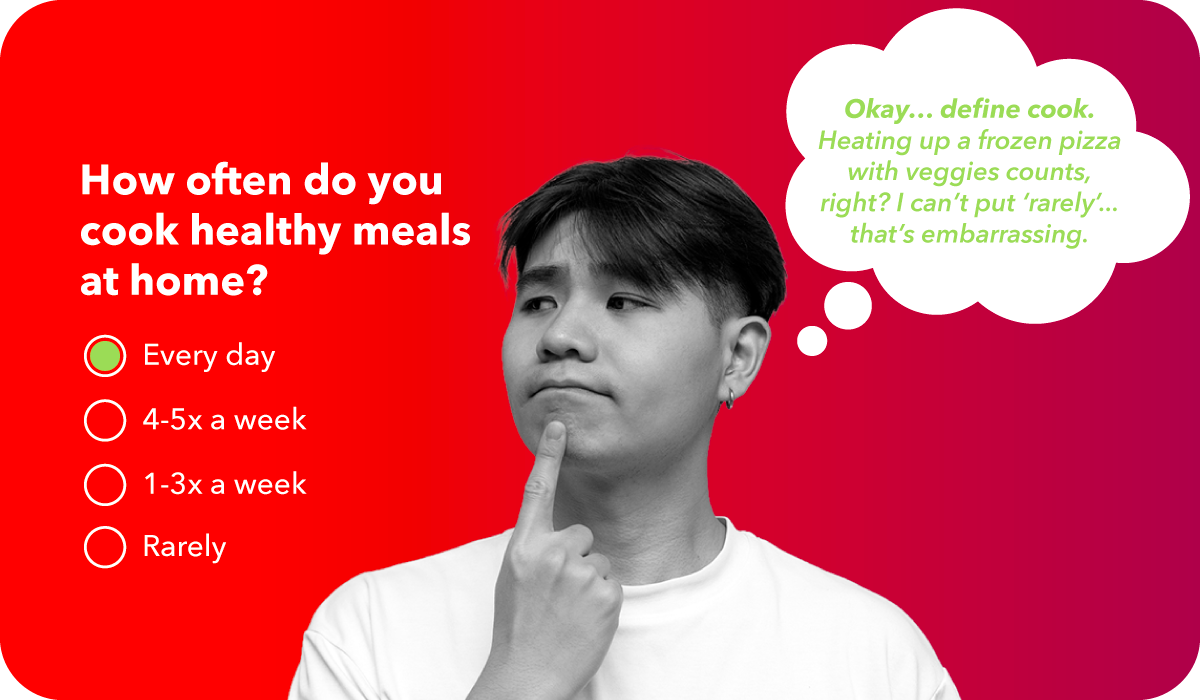
Social desirability bias is what causes individuals (and in this context, survey respondents) to answer questions in ways they believe will be viewed favorably by researchers, others, or even themselves, rather than giving wholly truthful answers.
This quirk, whether conscious or unconscious, is magnified by the very nature of surveys, which aim to collect honest answers that researchers and brands then use to make big decisions. But surveys are not where audiences live; they’re not the norm. They’re controlled environments and lack the nuance of day-to-day reality. When respondents see their answers reflected back to them in a survey, the pressure to be socially “desirable” mounts in a way that it doesn’t in the real world.
Exaggerating positive behaviors
When under the pressure of taking a survey, respondents are more likely say they exercise regularly, eat healthily, recycle, floss, or buy ethical or sustainable products more than they actually do.
While it can be an effective strategy to market towards your audience’s aspirations, this manifestation of social desirability bias could cause teams to massively overestimate demand, which can be an expensive mistake.
This can be especially prominent for brands looking to size the market for premium, organic, or healthy lifestyle-type products and services.
Under-stating behaviors perceived as negative
Conversely, survey respondents are less likely to report honestly about embarrassing and irresponsible shopping habits, indulgences, or price-sensitive behavior.
For example, a potential customer might say that they don’t always buy the cheapest option of toilet paper available, but in reality, they do. This might not only cause brands to overestimate demand, but to totally misunderstand their customer on the whole as being not as price driven as they actually are.
Skewed concept testing
When presented with socially conscious or innovative product ideas, respondents may express a false enthusiasm for something like a more sustainable packaging redesign, a wellness product, or the like, without having real interest or intent to buy.
The consequences of this can lead to failed launches, or trouble converting interest to actual sales.
Sensitivities around demographics
Questions about income, spending habits, or any purchase that could be considered “politically charged”, like ones about buying from brands that have a controversial reputation, are especially likely to yield skewed data.
Respondents tend to respond based on what they believe aligns value-wise with their demographic, leading you to false conclusions around what segments of your audience resonate with what you’re offering.
The consequences of social desirability bias are many, but the main reasons to watch out for it are to avoid inflating your market size, inaccurate segmentation, and product development driven purely by aspirational consumer personas; not real behavior.
That's the beauty of testing in the wild; social desirability bias dissolves when it feels like nobody is watching. It also yields richer, more nuanced data points based on real-life behavior and real-world interests and values, because you’re not selling to your customers in a vacuum.
Stop guessing based on biased data

Joe Corace
Joe is a seasoned consumer insights executive with two decades of experience driving growth and innovation across global markets. His expertise spans multiple sectors, including consumer packaged goods, alcoholic beverages, retail, financial services, and healthcare. He currently serves as Orchard’s Chief Customer Officer. Widely recognized for his strategic acumen, Joe has consistently delivered actionable insights that inform C-suite decision-making for many Fortune 100 companies. He is also known for cultivating and expanding high-value client relationships, leading transformative sales strategies, and unlocking long-term value for both external clients and internal shareholders. Most recently, Joe served as Senior Vice President at Behaviorally, where he was tapped to lead the revitalization of the Midwest Region. In this role, he oversaw client acquisition, market expansion, and retention - transforming the office into a high-performing, multi-million-dollar operation. Earlier in his career, Joe held client leadership roles at top-tier firms including Kantar (Millward Brown), Nielsen (BASES), Maru/Matchbox, and Verve, where he consistently delivered commercial impact through customer-centric insight and innovation.